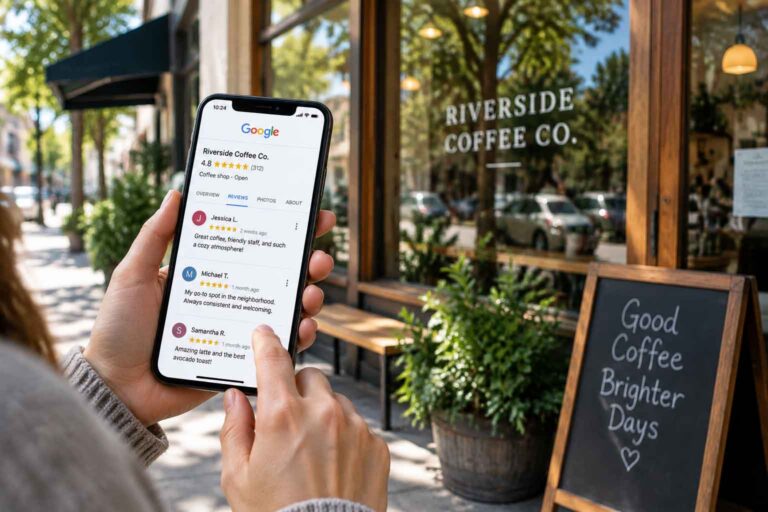
Google blocked 240 million fake or policy-breaking reviews in 2024 alone. Despite that, fake reviews remain one of the most persistent threats to local businesses. BrightLocal’s 2026 Local Consumer Review Survey found that 97% of consumers believe businesses should face punishment for posting fake reviews, and 77% of consumers say negative reviews make them less likely to choose a business.
If someone posts a fake 1-star review on your Google Business Profile, you’re not just losing one rating point. You’re potentially losing customers who never even considered you.
This guide covers how to identify fake reviews on your profile, what Google’s policies actually allow you to do about them, and how to build a review presence that holds up even when someone tries to undermine it.
How to Spot Fake Google Reviews on Your Business Profile
Not every negative review is fake, and not every suspicious review is worth reporting. Knowing what to look for saves you time and strengthens your case when you do flag something to Google.
Common Signs of a Fake Negative Review
Fake negative reviews are the ones that directly damage your business. They typically come from competitors, disgruntled former employees, or people who were never actual customers.
Watch for these indicators when a negative review appears on your profile:
- No record of the reviewer as a customer in your booking system, CRM, or transaction history
- Vague complaints that don’t describe a real experience, such as “Terrible place, don’t go here” with no detail about what went wrong
- The reviewer has a pattern of leaving 1-star reviews on multiple businesses in your industry or geographic area within a short period
- The review references services or products you don’t offer, which indicates the reviewer is either confused or fabricating the experience
- The reviewer’s profile was created very recently, sometimes within days of the review being posted
If a review matches three or more of these signs, it’s worth investigating further before you report it.
Patterns That Indicate a Coordinated Attack
Sometimes fake reviews don’t come one at a time. A coordinated attack typically involves multiple 1-star reviews appearing within a short window, sometimes within 24 to 48 hours.
The reviewers may have no review history, no profile photos, and no connection to your area. In some cases, the language across the reviews will be similar enough to suggest a single source.
This type of activity is more common than most business owners expect. If you notice a sudden spike in negative reviews from accounts that don’t match your customer base, document the timing, take screenshots, and prepare to escalate through Google’s reporting process.
What Google’s Content Policies Actually Cover
Google doesn’t remove reviews just because they’re negative or because you disagree with them. Removal only happens when a review violates one of Google’s published content policies.
The Six Categories Google Will Remove
Understanding which categories qualify for removal helps you build a stronger case. Google’s content policies cover the following:
- Spam and fake content: Reviews that are fabricated, posted by bots, or part of a mass campaign designed to manipulate a business’s rating
- Conflicts of interest: Reviews posted by competitors, current or former employees, or anyone with a financial relationship to the business or its competitors
- Impersonation: Reviews posted by someone pretending to be a person they’re not, including using a fake name to conceal their identity
- Hate speech: Reviews containing threats, discriminatory language, or personal attacks that go beyond a negative customer experience
- Off-topic content: Reviews that don’t describe an actual customer experience with the business, including political statements, personal rants, or content about a different business entirely
- Sexually explicit or dangerous content: Reviews containing graphic material or content that promotes harmful activities
If a review on your profile falls into one or more of these categories, you have grounds to flag it. Reviews that are simply negative, poorly written, or based on a misunderstanding don’t qualify for removal under these policies.
How to Report Fake Google Reviews
Identifying a fake review is the first step. The next step is getting Google to act on it, which requires a specific process and sometimes persistence.
Flagging a Review Through Google Business Profile
Google’s built-in reporting process is the starting point for any review removal request. The process is straightforward but limited. To flag a review, follow these steps:
- Log into your Google Business Profile and navigate to the Reviews section
- Find the review you want to report and click the three-dot menu next to it
- Select “Report review” and choose the reason that best matches the policy violation
- Submit the report and wait for Google’s moderation team to review the request
Google typically responds within a few business days, though it can take up to two weeks during busy periods. You won’t receive a detailed explanation of their decision. The review will either be removed or it won’t.
One important detail: Google allows only one formal appeal after an initial denial. That means your first submission matters. Don’t flag a review with a vague “spam” label if the real violation is a conflict of interest. Match the flagging reason to the actual policy category.
Escalating When Google Doesn’t Act
A single flag doesn’t always produce results. If your initial report is denied and you believe the review clearly violates Google’s policies, you have a few escalation paths available:
- Appeal through the Google Business Profile support form, providing additional context and evidence that the review violates a specific policy
- Contact Google Small Business Support directly through chat or phone to explain the situation and request a second review
- Post in the Google Business Profile Community forums, where Product Experts and Google representatives sometimes intervene on flagged cases that were incorrectly denied
Escalation works best when you have documentation. Screenshots of the reviewer’s profile showing no other activity, evidence that the reviewer was never a customer, or proof that the reviewer is a competitor all strengthen your case.
When to Hire a Professional Review Removal Service
Self-reporting through Google’s tools works for straightforward cases, but it has limits. Google’s moderation system is automated at scale, and legitimate reports get denied regularly. Some reviews require a more structured approach: a formal policy violation case, supporting documentation, and repeated escalation through multiple channels.
A professional review removal service handles this process on your behalf. They assess each review for policy violations, build the documentation, manage the flagging and escalation process, and follow up until the review is resolved. This is particularly valuable for businesses dealing with multiple fake reviews, coordinated attacks, or reviews that Google initially declined to remove.
The Legal Side of Fake Google Reviews
Beyond Google’s own policies, fake reviews now carry legal consequences at the federal level. Understanding the legal landscape helps you evaluate your options when reporting alone isn’t enough.
The FTC’s Final Rule on Fake Reviews
In August 2024, the Federal Trade Commission published a final rule banning fake reviews and testimonials. The rule makes it illegal to create, sell, or purchase fake reviews, and it applies to businesses and individuals who buy them as well as the services that produce them.
The rule covers several specific practices:
- Creating or selling fake consumer reviews attributed to people who don’t exist or who didn’t use the product or service
- Buying positive or negative reviews to inflate your own rating or damage a competitor’s
- Insider reviews written by employees or owners without disclosing the relationship
- Suppressing negative reviews by threatening or intimidating reviewers
- Selling fake social media indicators such as followers, likes, or views to misrepresent influence
Violations can result in penalties of up to $51,744 per incident. BrightLocal’s 2026 survey found that 57% of consumers believe businesses caught using fake reviews should be banned from review platforms, and 46% want those businesses removed from Google search results entirely.
Can You Sue Over a Fake Google Review?
If a fake review crosses into defamation (a false statement of fact that damages your business), you may have legal grounds for a lawsuit.
Defamation claims involving online reviews have been pursued successfully, though they require proving that the review contains false factual claims (not just opinions), that the reviewer knew or should have known the claims were false, and that your business suffered measurable harm as a result.
This is not a step to take lightly. Legal action is expensive, time-consuming, and public. For most businesses, the combination of Google’s reporting process and professional removal services resolves the issue faster and at lower cost.
Legal action is typically reserved for cases involving sustained, deliberate campaigns or reviews that make specific false claims (like alleging health code violations or criminal activity) that cause documented financial harm.
(Note: This section is general information, not legal advice. Business owners should consult an attorney for guidance on their specific situation.)
How to Protect Your Business From Fake Reviews
Reacting to fake reviews is necessary, but building a profile that’s resistant to their impact is the stronger long-term strategy.
Build a Review Profile That’s Resilient
The math behind Google’s star rating works in your favor when you have volume. A business with 15 reviews that receives one fake 1-star review takes a significant ratings hit. A business with 150 reviews absorbs the same fake review with barely a visible change.
Our Google review calculator breaks down exactly how many 5-star reviews it takes to reach your target rating from any starting point. Building that volume requires consistent effort.
The most effective approaches include asking customers for reviews at the point of highest satisfaction, sending follow-up emails or texts with a direct Google review link, and placing review QR codes at your physical location. BrightLocal’s 2026 data shows that 83% of consumers who were asked to leave a review actually did.
For businesses that need to build volume faster than organic methods allow, a Google review service can accelerate that buffer. A strong base of legitimate reviews doesn’t just improve your rating. It dilutes the impact of any single fake negative that lands on your profile.
Monitor Your Reviews Consistently
The faster you catch a fake review, the faster you can act on it. Letting a fake 1-star review sit on your profile for weeks while potential customers scroll past it costs you business every day it stays up.
Effective monitoring involves checking your Google Business Profile at least weekly (daily if you’re in a competitive market), setting up Google alerts for your business name so you’re notified when new reviews appear, and keeping a log of flagged reviews with screenshots, dates, and reporting status so you can track which reports are pending and which need escalation.
The businesses that lose the most to fake reviews are the ones that don’t check their profiles regularly enough to respond quickly.
Frequently Asked Questions
Is there a way to tell if Google reviews are fake?
There’s no single test, but there are reliable indicators. Check the reviewer’s profile for a photo, review history, and Local Guide status. Look at whether the review mentions a specific experience or uses vague, generic language.
Check whether the timing coincides with multiple similar reviews from accounts with no history. A combination of these signs is a stronger indicator than any one of them alone.
Are fake Google reviews illegal?
Yes. The FTC’s August 2024 Final Rule on the Use of Consumer Reviews and Testimonials makes it illegal to create, sell, or purchase fake reviews.
Violations can result in penalties of up to $51,744 per incident. The rule applies to both the businesses buying fake reviews and the services producing them.
Does Google care about fake reviews?
Google blocked 240 million fake or policy-breaking reviews in 2024. They invest heavily in automated detection systems and maintain a content policy that covers spam, conflicts of interest, impersonation, hate speech, off-topic content, and dangerous material. That said, Google’s automated systems don’t catch everything, and legitimate reports are sometimes denied. Persistence through flagging, escalation, and appeals is often necessary to get a fake review removed.
Can I sue someone for a false Google review?
If a review contains false statements of fact (not just negative opinions) that damage your business, you may have grounds for a defamation claim. You’d need to prove the statements are factually false, that the reviewer knew or should have known they were false, and that your business suffered measurable harm. Consult an attorney for advice specific to your situation.
Can you get fake Google reviews removed?
Yes, but only if the review violates one of Google’s content policies. Flag the review through your Google Business Profile, match the flag reason to the correct policy category, and be prepared to escalate through Google’s support channels or the Business Profile Community forums if the initial report is denied. For reviews that require more documentation or repeated escalation, a professional review removal service can manage the process.