
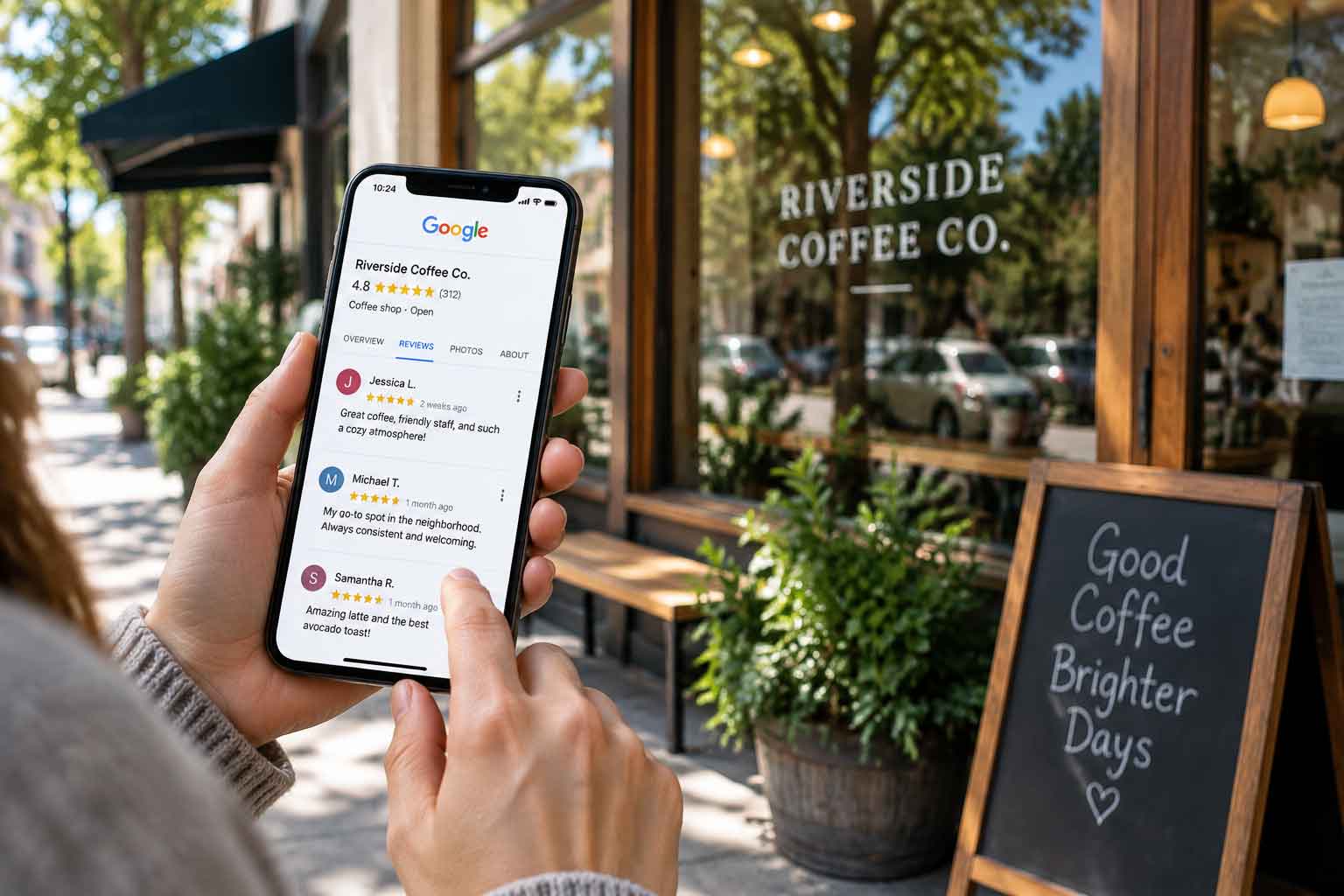
Yes. Google reviews help SEO, and Google confirms it on the same Business Profile help page that explains how local ranking works.
Reviews work through prominence, one of the three factors Google uses to order local results alongside relevance and distance. They also shape which listing a searcher clicks once the results appear, which is a separate effect that most guides blend into the first.
If you’re asking because your competitor with 300 reviews keeps outranking you, this guide explains exactly which review signals matter, which ones are overstated, and what reviews cannot fix.
How Does Google Decide Local Rankings, and Where Do Reviews Fit?
Google publishes how local ranking works on its Business Profile help page, and the framework has stayed consistent for years. Local results are based on three things.
- Relevance: how closely your Business Profile matches what the person searched for. Categories, services, and business details drive this.
- Distance: how far your business is from the searcher or the location named in the search. You can’t change it.
- Prominence: how well known your business is, both offline and across the web. Google states that this includes links to your business, mentions in articles and directories, and the number of reviews you have.
Reviews live entirely inside that third factor. Google’s page states that more reviews and positive ratings can help your local ranking, which is as close to a confirmed ranking factor as Google ever gets.
In practice, that makes review count and 5 star Google reviews the two prominence inputs a business has any direct control over.
Two other statements on that same page matter as much as the prominence line. Google says there is no way to request or pay for a better local ranking, and it keeps the algorithm details confidential to keep the system fair.
So when people ask, “Do reviews help SEO?” the accurate answer is that reviews are one input among three factors. Any honest list of local SEO ranking factors puts reviews next to links and citations, not above them.
One more distinction: this is about the local pack, the map results with three businesses at the top of the page. Reviews influence organic blue-link rankings far less, since those depend on your website rather than your profile.
Google names the factor but stops there. The next section fills in the mechanics Google leaves out.
What Are the Five Ways Google Reviews Affect Local Rankings?
Google names the factor but not the mechanics, which is why “do Google reviews help SEO” gets so many different answers online. These are the five review signals the evidence supports, ranked by how directly Google itself has confirmed them.
1. Review Count
Count works as a proxy for how many people have done business with you. A profile with 200 reviews looks more established to the algorithm than one with 12, in the same way a business with 200 press mentions looks more prominent than one with none.
Count is also the signal with the hardest consumer-side threshold. According to BrightLocal’s 2026 Local Consumer Review Survey, the source for every consumer figure in this guide, 47 percent of consumers won’t use a business with fewer than 20 reviews.
A small count hurts twice: once in ranking and again when the searcher sees the listing.
2. Star Rating
Rating measures a different dimension than count. Two businesses with 150 reviews each are not equal in Google’s eyes if one averages 4.7 and the other 3.9.
The consumer bar is rising fast. In the same survey, 31 percent of consumers said they’ll only use a business rated 4.5 stars or higher, up from 17 percent the year before, and 68 percent require at least 4 stars.
3. Review Recency and Steady Flow
Google does not publish a recency factor, but it does state that prominence reflects what Google knows about a business right now. A profile whose last review is 14 months old sends a weaker “active business” signal than one reviewed last week.
Steady flow matters more than any single month. A profile that collects a few reviews every week looks like a business with ongoing customers, making recency a matter of consistency more than timing.
It’s also the standard to hold any provider to if you buy Google reviews: gradual delivery that matches a normal week, not a batch that lands all at once.
Here’s where the answer gets a qualifier. A sudden burst of reviews after a long quiet period doesn’t look like growth to Google’s systems.
It looks like a pattern worth checking, which we cover in the section on what reviews can’t do.
4. Review Content and Keywords
This is the most overstated signal in most guides, so let’s be precise about it.
Google’s help page says nothing about keywords in reviews affecting rank. The idea comes out of industry surveys of local SEO practitioners, where “keywords in reviews” regularly appears in the list of local SEO ranking factors as an expert opinion rather than a Google statement.
What is confirmed: Google reads review text closely enough to let searchers filter your reviews by keyword and to generate AI summaries of what customers mention most. Reviews that describe the specific service someone received give Google more to work with than “great place, five stars.”
The practical takeaway is to ask customers about their experience and let them describe it, rather than scripting keywords into requests, which violates Google’s policy.
5. Owner Responses
Ask any local SEO if responding to reviews helps SEO and you’ll get a confident yes, but the confirmed part is narrower than the claim.
Google’s ranking page lists “respond to reviews” as a recommended action, stating that positive reviews and helpful replies can help your business stand out. It does not say responses are a ranking input.
Where responses clearly pay off is conversion. The same survey found 80 percent of consumers are more likely to use a business that responds to all of its reviews, and 42 percent are unlikely to use one that never replies.
How much responding to reviews helps depends on how you respond. Generic or templated replies put off 50 percent of consumers in that survey, so a token reply can cost you the customer the review itself would have won.
Do Google Reviews Affect Both Rankings and Click-Through Rates?
The question “do Google reviews affect SEO” usually hides a second question: do reviews affect who gets the click? The answer is yes to both, and the two effects work through different mechanisms.
Ranking gets you onto the map, and that’s where most answers to “do Google reviews help SEO” stop. Reviews then decide what the searcher does once three listings appear side by side, with star ratings and review counts displayed next to each one.
The same survey shows how much weight that second job carries:
- 97 percent of consumers read reviews for local businesses, and 41 percent read them every single time they look for one
- 85 percent say positive reviews make them more likely to use a business, while 77 percent say negative reviews push them away
- 74 percent only care about reviews written in the last three months, so a top-ranked listing with stale reviews still loses the click
- 49 percent trust online reviews as much as recommendations they get in person
- 45 percent used ChatGPT or other generative AI tools for local business recommendations in 2026, compared with 6 percent the year before, and those tools draw on review data
That last point is the newest reason Google reviews and SEO belong in the same conversation, and it’s the part most guides haven’t yet addressed. AI Overviews on Google and answers in ChatGPT summarize what reviews say about a business, so review content now influences visibility in places that didn’t exist three years ago.
Put the two jobs together, and the answer becomes concrete. A listing in position three with a 4.8 rating and recent reviews can outperform position one with a 4.1 and nothing new since last spring, because the ranking gets both seen, and the reviews decide who gets called.
That rating gap is what businesses are paying to close when they purchase Google reviews, and it’s worth more than the position itself.
What Can’t Google Reviews Do for Your Rankings?
Any honest answer to how Google reviews affect SEO includes the limits. Reviews are powerful inside their lane and useless outside it.
Businesses waste money when they treat reviews as a fix for a wrong category or a bad location, and the same four limits apply to local SEO reviews on Yelp, Facebook, or any other platform.
They Can’t Overcome Distance
If a searcher is standing two miles away and your competitor is across the street, reviews will not close that gap for most searches.
Distance is one of Google’s three factors and the only one you can’t influence. Reviews help you win against businesses at a similar distance, not against businesses next door to the searcher.
They Can’t Replace a Complete Profile
Relevance comes before prominence in Google’s own ordering, and relevance is built with your primary category, secondary categories, services, attributes, and business description.
A plumber with 400 reviews and the wrong primary category will lose to a plumber with 60 reviews and the right one.
Reviews amplify a well-built profile. They don’t compensate for a broken one.
Bursts of Reviews Can Backfire
Google’s content policy flags “unusual volumes or patterns of review contributions” as a sign of rating manipulation, and its systems watch the pace on the receiving profile, not just the individual reviewer.
Fifteen reviews in three days on a profile that normally gets two a month invites scrutiny of the whole batch, including the genuine ones. Reviews that get filtered as a result don’t count toward prominence.
This is the third side of the timing issue. Recency is the ranking signal, freshness is what wins the click, and pace is the policy risk, and all three point to the same steady weekly cadence. Our guide on why Google reviews disappear explains what happens when a batch gets filtered.
Reviews Google Removes Don’t Count
A review only helps your ranking while it’s live. Google reports that it blocked or removed more than 292 million policy-violating reviews in 2025, and that none of them contributed anything.
Incentivized reviews, reviews solicited only after happy visits, and reviews written to a script all violate Google’s policy and are the first to go. Local SEO reviews that survive are the ones that arrive naturally, at a steady pace, in the customer’s own words.
The same policy standard works in your favor when a fake or competitor review appears on your profile, since a policy violation is the only basis Google accepts for removing negative Google reviews.
How Do You Turn Google Reviews Into Local Ranking Gains?
Everything above reduces to one principle, and it settles the question for good. The review signals Google confirms, count and rating, only grow through reviews that stay live, and reviews stay live when they look like the natural output of a busy business.
Build your review program around that:
- Ask every customer, every week. Continuous requests increase both count and recency, and the same survey found that 83 percent of people asked to leave a review did so. Our post on how to get more Google reviews covers effective request methods.
- Send requests after the visit, not during it. Reviews left on the customer’s own device and connection avoid the filters that catch on-premises reviews.
- Never attach an incentive. A discount for a review violates policy and can cost you the reviews it produced.
- Respond to every review within a week. Responses don’t rank you directly, but 80 percent of consumers are more likely to use a business that responds to all of its reviews. Our guide on how to respond to Google reviews covers writing replies that read as personal.
- Set a rating target and work out how many reviews it takes to get there. Our Google review calculator guide shows how many five-star reviews it takes to move a 4.2 to a 4.5.
- Spread requests across platforms. Prominence draws on signals across the web, not only Google, and the survey found consumers now use an average of six review sites when choosing a business.
- Deal with reviews that break Google’s rules. A fake or competitor review drags your rating down and does nothing for count. Our negative Google review removal service assesses eligibility at no charge, and our guide to what removal costs and how it works explains the process.
Google reviews and SEO make up a long game, and most businesses lose it by starting late rather than by doing it wrong. A profile that adds a handful of reviews every week for a year ends up with the count, rating, and recency that Google rewards and that consumers now demand.
If your review profile is starting well behind competitors who have been collecting for years, we can help close the gap. Businesses can buy Google 5-star reviews through us, delivered gradually so the pace matches what Google expects, and pair that with a request program that keeps the count growing on its own.
Reach out, and we’ll look at how your profile compares to the businesses ranking above you.