
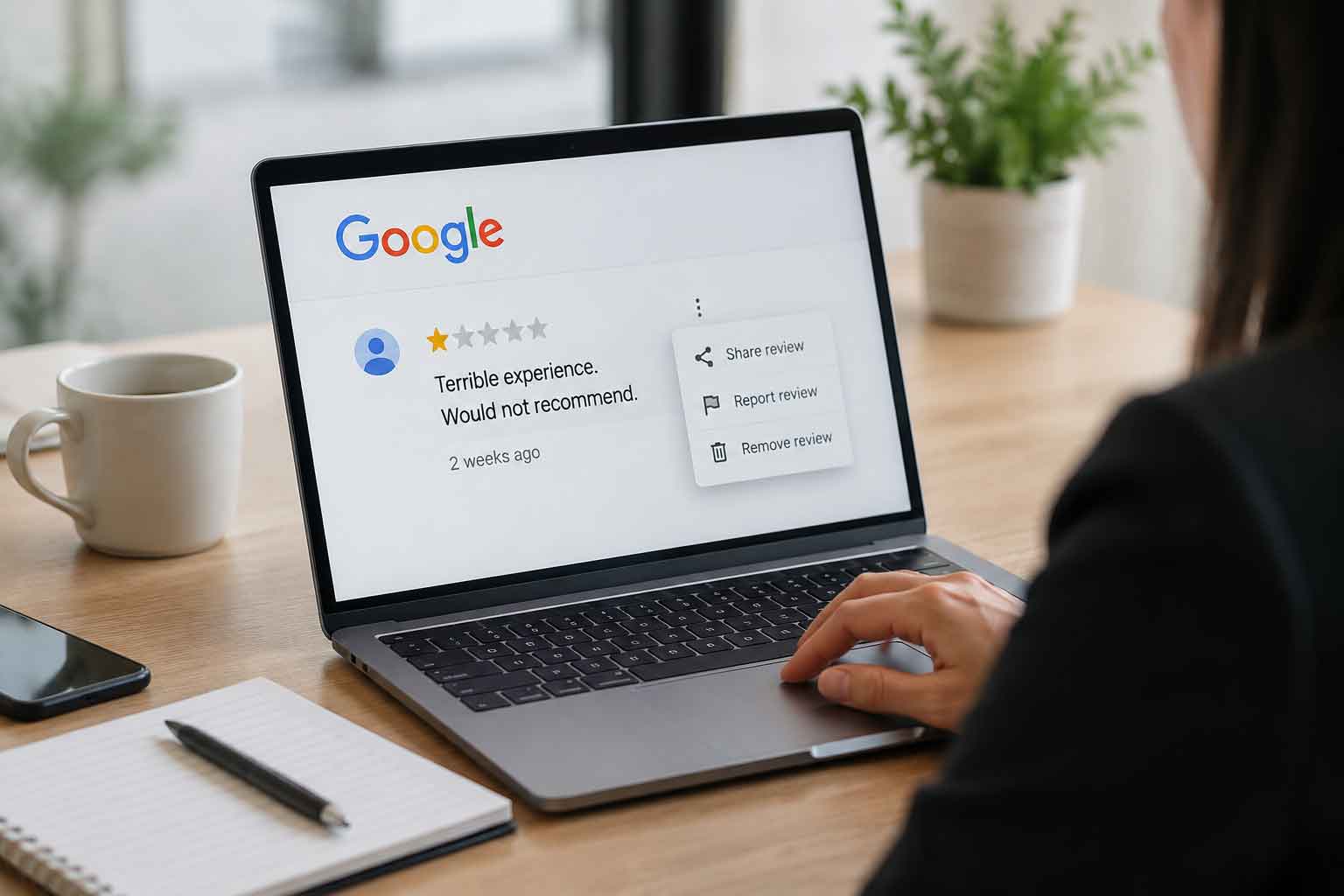
A Google review removal service identifies reviews that violate Google’s content policies, documents the violation, and submits the case through Google’s official reporting and appeal channels on your behalf.
Reputable providers quote a fee for each review after a free assessment and bill only once the review comes down. No provider can remove an honest negative review, and none can promise a perfect success rate, because Google makes every final decision.
If you’re weighing a Google review removal service against handling it yourself, this guide covers the full process, which reviews qualify, how pricing works, and what separates the best Google review removal service in the market.
How Does a Google Review Removal Service Work?
Every credible provider follows the same four-step structure. The differences show up in how carefully each step is done.
Google publishes the reporting and appeal process for business owners, so a Google review removal service isn’t using a secret channel. It’s using the official one with more precision than most owners have time for.
Step 1: Free Assessment of the Review
The process starts with a look at the review itself, not your credit card.
A provider reads the review, checks the reviewer’s profile, and matches the content against Google’s prohibited and restricted content policy. The goal is a simple answer: does this review break a specific rule, or does it just hurt?
A good assessment ends with a no as often as a yes. If the review is a real customer describing a real experience, the provider should tell you it doesn’t qualify and stop there.
Step 2: Building the Policy-Violation Case
Once a review qualifies, the provider builds the case for Google review removal based on a specific policy.
This means naming the exact violation (fake engagement, conflict of interest, harassment, personal information, off-topic content) and gathering supporting evidence such as screenshots and reviewer profile activity. The case document then explains clearly why the review violates that specific rule.
It’s the same case an owner would need to remove negative Google reviews on their own. The provider’s job is to build it properly the first time.
The case matters because Google’s process is built on a limited number of attempts. Quality beats repetition, and a vague “this is fake” report gets the same treatment as no report at all.
Step 3: Reporting and Appealing Through Google’s Channels
The provider submits the report through Google’s Reviews Management Tool, which lets a business owner report a review, track its status, and appeal a decision.
Google states that assessing a reported review can take several days. If Google finds no violation, the status reads “Report reviewed, no policy violation,” and Google allows a one-time appeal on that decision for up to 10 reviews at once.
That one-time limit is the reason a documented case matters more than repeated flagging. A provider gets the report, and the appeal, and then the review is either removed or not removed.
Step 4: Confirmation, Billing, and Follow-Up
When Google removes the review, it stops showing on both Search and Maps, and Google emails the result of any appeal.
A pay-after-removal provider bills at this point and not before. The provider should also confirm the removal on your live profile rather than relying solely on the tool’s status.
Follow-up covers what happens next. Some providers offer a repost warranty that re-removes the review if the same person posts it again within a set window, so ask about that before you sign.
The one variable no provider controls is timing, which is the question most owners ask next.
How Long Does It Take to Remove a Google Review?
Ask any provider how long it takes to remove a Google review, and the honest answer is “it depends on Google.”
Google’s own guidance says each assessment can take several days, and an appeal adds another cycle. Providers in the market publish turnaround windows ranging from one week to one month, with older or more complex reviews taking longer.
Treat any promise of removal within 24 hours as a warning sign. Google controls the clock, not the provider.
Can Google Reviews Be Removed? What Qualifies and What Doesn’t
Business owners ask us one question more than any other: can Google reviews be removed at all? The answer is yes, but only when the review violates a written policy.
Google is direct about this: you can report any review, but only those that break a written policy are eligible for removal. Google doesn’t arbitrate disagreements between businesses and customers.
Reviews that typically qualify for Google review removal:
- Fake reviews: content that isn’t based on a real experience, or that was paid for or posted at someone’s request
- Conflict of interest: reviews written by competitors, current or former employees, or their family members
- Harassment and hate speech: threats, doxxing, or attacks based on a protected characteristic
- Personal information: a staff member’s full name, photo, or private details posted without consent
- Off-topic content: political commentary, personal rants, or complaints about a different business
- Spam and repetition: the same text posted across multiple accounts or profiles
- Extortion: reviews posted as leverage for payment, which Google now handles through a dedicated reporting path
Reviews that will not qualify no matter who submits the case:
- An unhappy customer describing a real visit, even if the details feel unfair
- A rating with no text, left by someone who did not do business with you
- A review that criticizes pricing, wait times, or staff attitude without breaking a policy
- A review you believe is exaggerated but cannot show is false
Before you hire anyone, try Google’s free path once. Report the review through the Reviews Management Tool, wait for the decision, and use your one appeal if the first report fails.
If that path doesn’t work and the review clearly violates a policy, a service to remove Google reviews adds the case-building and persistence that most owners don’t have time for. If the review doesn’t violate a policy, the better investment is a public response.
The other investment that works is volume. A steady flow of new reviews, earned through requests or added when you buy Google reviews, leaves the one that stays carrying less weight.
How Much Does a Google Review Removal Service Cost?
Pricing in this market confuses buyers because providers structure it in three different ways. Understanding the models matters more than any single number.
How Providers Structure Their Pricing
Most providers charge a flat fee per removed review. Some publish the fee, some quote it after an assessment, and some bundle removal into a monthly reputation retainer that also covers monitoring and response.
The Google review removal cost you’re quoted depends on which of those three models the provider uses, so compare like with like. A per-review fee and a monthly retainer are not the same product.
Why the Quote Comes After the Assessment
Owners often ask how much it costs to remove a Google review before sharing the review itself. Reputable providers can’t answer that yet, and here’s why.
The work involved changes with the review:
- Age: reviews that have been live for months are indexed more deeply and typically need more documentation than a review posted last week
- Format: image-based reviews often violate policy through the image itself, which changes the case
- Volume: a coordinated attack of several reviews is built as one case, not five separate ones
- Complexity: reviews tied to legal claims or ongoing disputes can require escalation beyond the standard tool
A quote after assessment reflects the actual work. A flat public price either overcharges simple cases or undercharges hard ones.
Pay After Removal vs. Deposits vs. Retainers
The billing model indicates how much risk the provider is willing to assume.
- Pay after removal: you owe nothing unless the review comes down. The provider absorbs the cost of failed cases, so it has every reason to decline reviews that don’t qualify.
- Refundable deposit: you pay upfront and receive a refund if removal fails. Lower risk than a non-refundable fee, but your money sits with the provider during the process.
- Monthly retainer: you pay for ongoing reputation management, and removal is one of the services included. This suits businesses with multi-platform problems, not a single bad review.
For a single review or a small cluster, pay after removal is the model that keeps the provider honest. It’s the standard among established removal specialists, and it’s the model we use.
What You Should Never Pay For
Some offers in this market should end the conversation:
- Upfront fees for reviews the provider hasn’t assessed
- Guarantees of a 100 percent success rate, since Google’s moderation team makes every removal decision and no provider controls that outcome
- Promises to remove any review, including honest ones
- Bulk “flagging campaigns” that spam Google’s report button, which can draw scrutiny to your own profile
- Any offer to post negative reviews on a competitor, which violates Google policy and creates legal exposure
If a provider leads with any of these, the low price isn’t a bargain.
Our Pricing: A Quote After a Free Assessment
Our pricing is specific to your review. Here’s what that means in practice.
Send us the review, and we’ll assess it against Google’s policies at no charge. If it qualifies, you receive a quote for that specific review before any work starts.
If it doesn’t qualify, we’ll tell you that instead. So if you’re asking how much it costs to remove a Google review, the answer is that the cost is tied to your review, not a rate card.
You pay after the review is removed, not before.
For the rest of what we offer, including what it costs to purchase Google reviews, see our pricing page.
How Do You Choose a Google Review Removal Company?
The best Google review removal service for your business is the one that’s willing to turn you down. Everything else on the checklist flows out of that.
Use these questions when you compare providers:
- Do they assess first and decline reviews that don’t qualify? A Google review removal company that accepts every case is charging you for reports Google will reject.
- Do they ask only for your public profile link? No legitimate Google reviews service needs your Google password or access to your Business Profile account.
- Can they name the policy the review violates? “It’s fake” isn’t a case. “It’s a conflict of interest, and here’s the reviewer’s employment history” is.
- Do they explain the one-time appeal limit and what they’ll do if it fails?
- Do they cover reposts? Ask what happens if the same person leaves the same review again after you’ve paid.
- Do they bill after removal? Any other model shifts the risk onto you.
- Do they refuse to attack competitors? A provider willing to post negative reviews for you is a provider willing to post them about you.
If removal isn’t an option, the remaining moves still work. Respond to the review publicly and professionally using the approach in our guide on responding to Google reviews, report any pattern of fake reviews using the steps in our guide to spotting and reporting fake Google reviews, and grow your review count so one bad review carries less weight.
Our post on how to get more Google reviews covers the request side. Businesses that need faster reinforcement can also buy Google 5-star reviews through us, delivered gradually so the new activity matches a natural pattern.
When a review does break Google’s policies, our negative Google review removal service handles the assessment, the case, the report, and the appeal. Send us the review for a free assessment, and we’ll let you know within a few days whether it qualifies and what removal would cost.